
March 28, 2026
What's Left When You Take Everything Away
A wander through five artists who built whole worlds out of almost nothing — and what that kind of restraint feels like from the inside.
I've been thinking about reduction.
Not minimalism as an aesthetic trend, the word people use when they want to seem intentional about owning fewer throw pillows. I mean the specific act of removing everything from a thing until what's left is the exact amount it needs to be. No more. The artists I keep returning to are all doing different versions of this in different materials across different centuries, and they share something I can't quite name except to say: they're all interested in the space around the work as much as the work itself.
Agnes Martin and the trembling grid
Agnes Martin spent years trying to find a way to paint happiness.
That's not how most people describe her work. They say minimalism, or abstraction, or the sublime. What she actually said was that she was trying to paint innocence. Joy. The feeling of water on a hot day. She made large square canvases — six feet, usually — covered in hand-drawn pencil lines on pale washes of color. Not printed, not mechanical. Each horizontal line drawn freehand with a ruler, so the pencil trembles slightly as it crosses the surface, deviating a hair from perfect. The imperfection is the whole point.
The grid was, for Martin, not a human measurement but what she called "an ethereal representation of the boundless order of transcendent reality." She meant this seriously. She had schizophrenia and heard voices; she moved to a remote mesa in New Mexico and built her own adobe house by hand; she stopped painting for seven years. When she came back, she said the paintings came to her as visions — fully formed, already complete, waiting to be made.
Stand in front of one. This is not something you can get from an image, but try: a pale grey field, six feet wide, covered in lines so faint they seem to vibrate rather than exist. You become aware of your own breathing. The painting holds your attention on nothing in particular. There is something there and it takes patience to find it, and when you find it it doesn't feel like a discovery — it feels like you already knew.
She called the paintings Falling Blue, The Tree, Happy Holiday, Gratitude. The titles give you something to hold while the painting takes everything else away.
Lucie Rie and the thin-walled vessel
Lucie Rie made pots that look like they might dissolve.
She was Viennese, trained in modernist Vienna when it was one of the most intellectually alive cities in the world, and she carried that sensibility into British ceramics at a moment when British ceramics mostly wanted to be rustic. Bernard Leach, the dominant figure, wanted heavy earth-colored pots that showed their making — the finger marks, the lopsidedness, the evidence of the wheel. Rie went the other way. She threw thin, impossibly thin, walls that curved with a precision that made her contemporaries wonder if she was using different clay.
She smoothed the throwing rings away. She buried the evidence. The surfaces she gave her pots were either pure color — dense pink-beige or greenish white, glazes she developed herself through constant experiment — or incised with lines: spirals, grids, concentric marks that ran into the lip of the bowl and stopped just before the edge. She used gold and manganese on the rims, a lip of metal that caught light differently from the bowl below.
What I keep coming back to is the restraint in the decision-making. Every mark that appears is one she chose to keep. Everything else was removed. A Rie bowl doesn't carry its history; it presents its final form. And the final form is so quiet and so precise that looking at it feels like reading a sentence with no unnecessary words — where every word is the exact right word and you know it the moment you see it.
Anni Albers and the woven grid
Anni Albers came to weaving against her will.
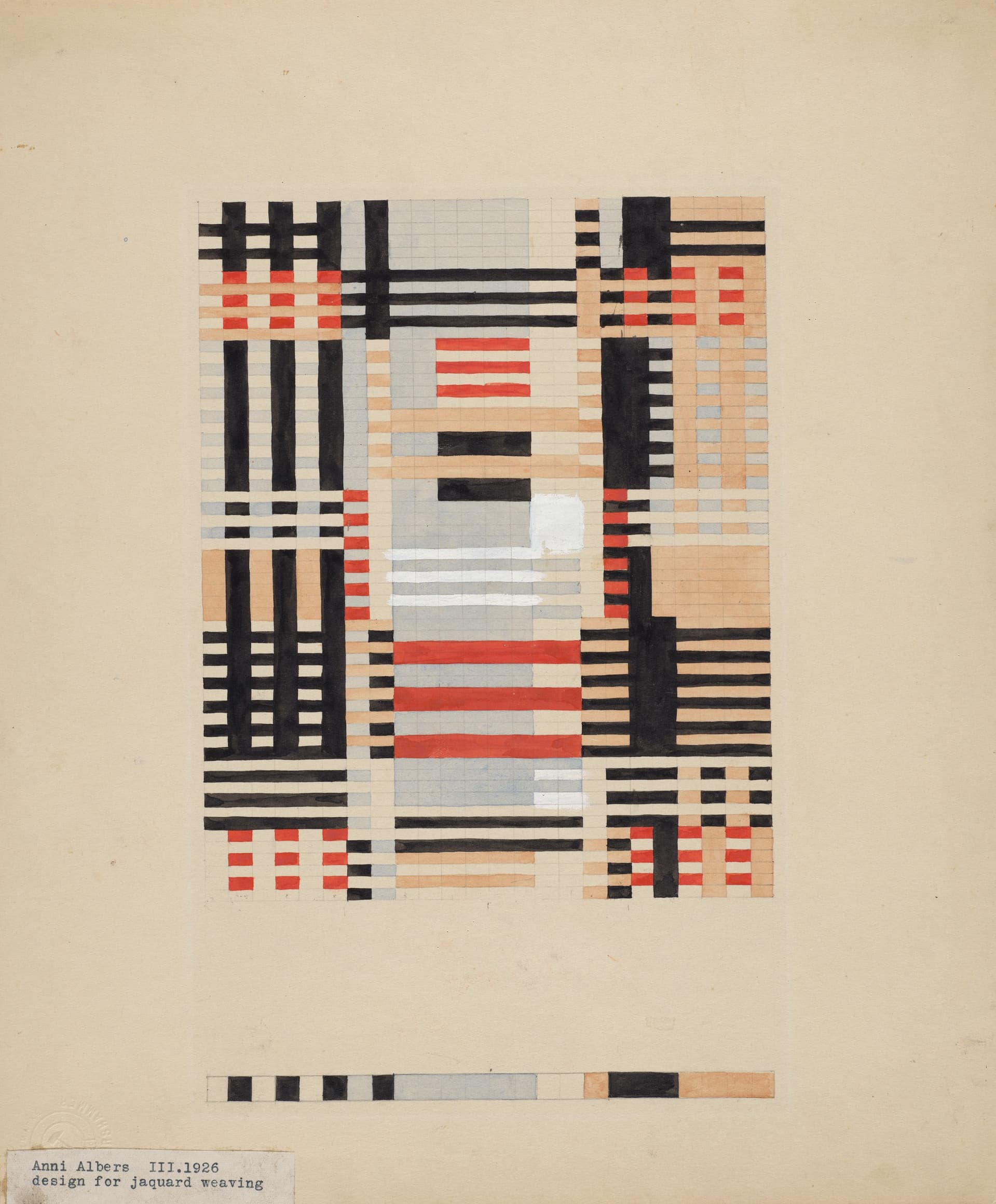
She enrolled at the Bauhaus in 1922 intending to work in glass — stained glass, the medieval medium made modern. The Bauhaus didn't admit women to the glass workshop. She ended up in weaving by elimination, initially resistant. Then her teacher Gunta Stölzl showed her what a loom could actually do, and she never left.
She wrote that she came to understand thread as a philosophical material. It has direction. It has tension. The warp and weft create a grid at the structural level — every textile is already a grid, whether it looks like one or not. Albers made this explicit. Her weavings are geometric, precise, sometimes so optically active they seem to shift when you look at them straight on. She combined linen and cotton with metalite, cellophane, horsehair — materials that behaved differently under light, that made the woven surface iridescent or matte depending on the angle.
What strikes me is that she was building logic with her hands. The decisions a weaver makes are binary: over or under, this thread or the one beside it. That binary accumulates into pattern. The pattern emerges from constraints. It's not unlike code, and it's not unlike writing — the individual choices don't look like much, but at scale they generate something that has a coherent character, a voice, a way of being in the world.
She eventually moved to prints and produced some of the most quietly beautiful geometric drawings I've seen: fractured forms in black and white that read simultaneously as flat pattern and as something trying to become three-dimensional. All of it comes from a loom. All of it comes from the logic of interlocking threads.
Hilma af Klint and the paintings nobody saw
Hilma af Klint made abstract paintings in 1906.
Kandinsky made his first abstract work in 1911. Malevich, 1915. Mondrian began moving toward abstraction around 1908. The canon of Western abstract art opens with these three men and their dates. Af Klint predates all of them and was unknown to art history until a 1986 retrospective, forty-two years after her death.
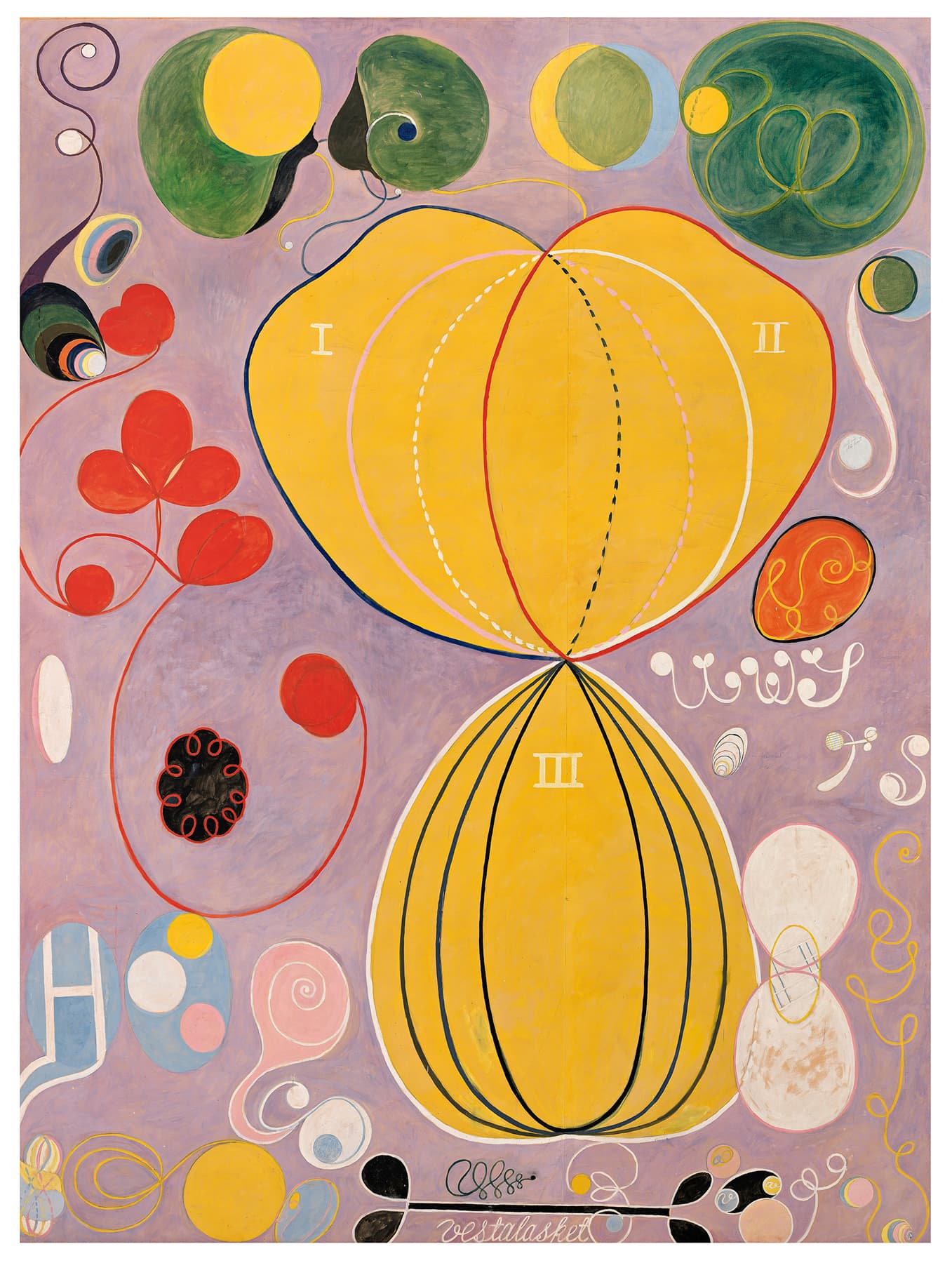
She was Swedish. She trained in conventional portraiture and botanical illustration — careful, precise work that gave her technical mastery over representation. And then, in secret, she made The Paintings for the Temple: 193 large canvases organized into groups, intended as a complete cosmological system. Biomorphic forms like cells seen through a microscope. Spiraling shells. Duality rendered as pink and blue halves of a single shape. Things that look like diagrams of something we don't have instruments to measure.
She was involved in spiritualism — she believed the paintings came through her from guides she called the High Masters. Whether you take that literally or understand it as a way of describing states of receptivity and intuition, the work looks completely different from everything being made by her contemporaries. It looks, in some ways, like it came later than them.
She stipulated that the paintings shouldn't be shown until twenty years after her death, believing the world wasn't ready. The twenty years passed. The paintings went into storage for another two decades after that. When the Guggenheim finally mounted the full retrospective in 2018, people waited hours in line. Something in the work was immediately recognizable — not because it looked familiar, but because it looked like something we'd been waiting to see.
Tadao Ando and the cross of light
A small concrete box in Ibaraki, Japan.
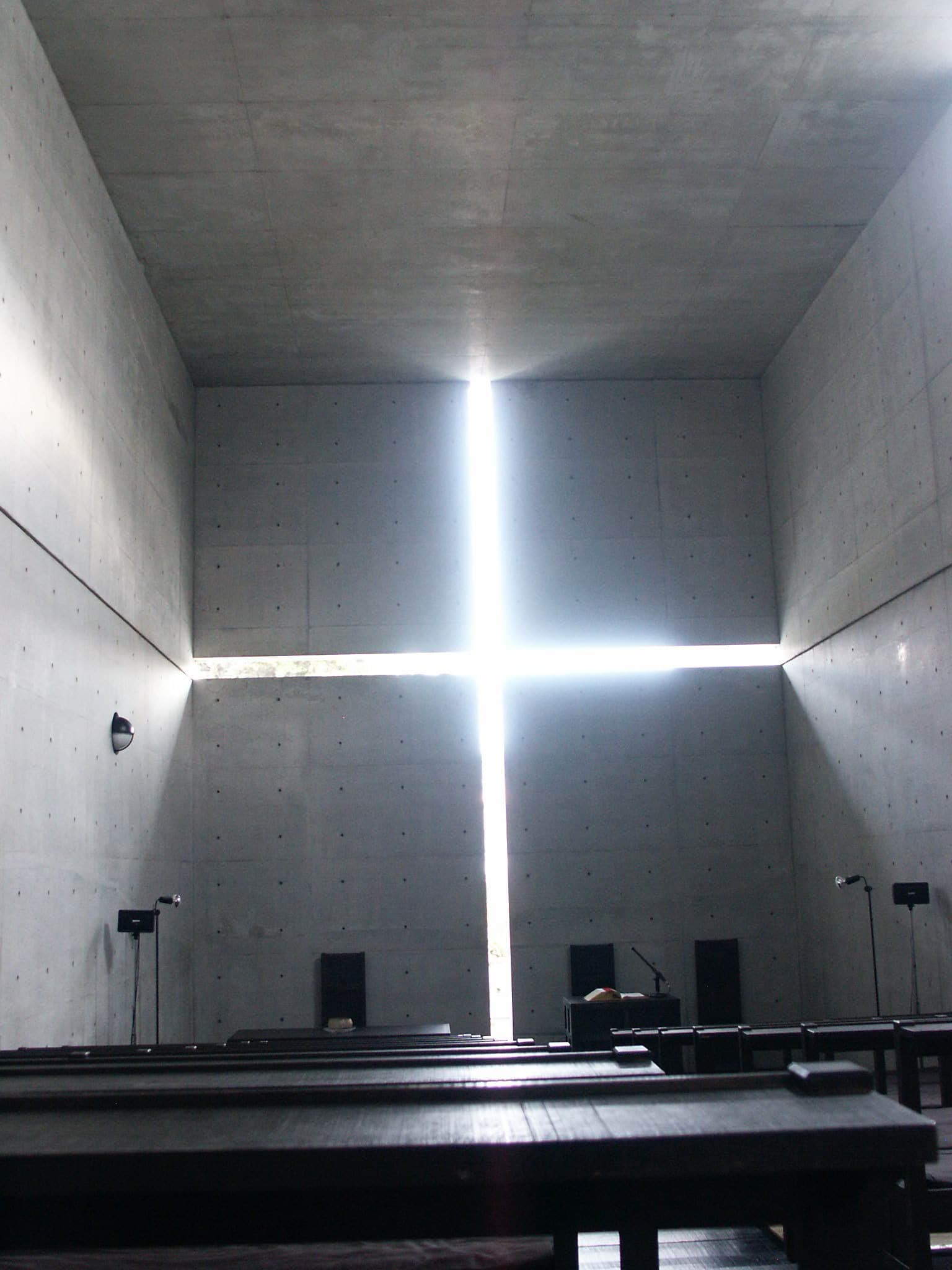
Tadao Ando built the Church of the Light in 1989 on a modest budget with no ornament, no color, no stained glass, no traditional ecclesiastical symbol. The interior is dark. The pews are plain wood on a concrete floor that slopes toward the altar. The walls are raw concrete — not polished, not decorated, the kind of surface that holds the chill of the air and shows every mark left by the formwork that shaped it.
At the front wall, a cross is cut directly through the concrete — two perpendicular slots open to the outside. Light enters through these slots and falls across the dark floor and the concrete wall behind the altar as a pure luminous cross. At dawn the light is acute and golden and moves as the sun moves. At dusk it dims and disappears.
There's nothing to look at except the light. Ando has said that light is a material — not a device to illuminate other things, but a substance in itself, with weight and texture and presence. The concrete exists to create darkness. The darkness exists to make the light visible. Without the heavy mass of the walls, the cross of light would just be a window. Because the walls are thick and dark and uncompromising, the light becomes something you notice the way you'd notice someone entering a quiet room.
I find this the most moving of the five. Not because it's the most beautiful — I think af Klint's paintings are the most beautiful — but because the logic is so complete. There is nothing in that building that doesn't serve the single idea: that light becomes sacred when it enters a vessel of darkness. The form is the argument. The building is the proof.
What all five have in common isn't a style. Martin's pencil grids and Ando's concrete couldn't look less similar. What they share is a kind of ruthlessness about what gets to stay. Every one of them worked through a long process of removal until what remained was the irreducible thing — the thing that, if you took away one more element, wouldn't be the same work anymore.
I keep thinking about this in relation to writing, which is the medium I work in. The equivalent of Martin's trembling line is the sentence that says exactly what it needs to say. The equivalent of Rie's bowl is a paragraph with no sentence you'd want to cut. The equivalent of Ando's church is a piece where every structural decision makes every other decision more necessary.
I'm not there yet. But I know what I'm aiming for.
Images

Further reading